Pros
- Easy setup and app control for room-by-room cleaning.
- Self-emptying base reduces bin handling.
- Strong fit for pet hair and mixed floors.
- LiDAR mapping and Matrix Clean add useful route control.
This Shark robot vacuum is aimed at anyone who wants a hands-off floor cleaner with self-emptying convenience, home mapping, and a clear focus on pet hair and mixed flooring. The appeal is obvious for busy homes with carpets and hard floors, especially if you want a machine that can run on a schedule and return to its base on its own. The trade-off is just as clear: the automation is useful, but the mixed ownership experience means the value depends heavily on whether you get a unit that behaves well in your home layout.
Buy it if you want a mapped, self-emptying robot for routine cleanup and you like the idea of less day-to-day emptying. Skip it if you need a robot that feels bulletproof out of the box or if your home has lots of tight obstacles, thresholds, or other trouble spots that make a robot’s routing more demanding. The strongest case here is convenience; the weakest point is that the experience is not uniformly smooth enough to make this an automatic recommendation at the price.
| Suction | Powerful suction |
|---|---|
| Navigation | 360° LiDAR vision and object detect |
| Dock | Bagless self-empty base with 60-day dirt and debris capacity |
| Mopping system | Not included |
| Battery life | 110 minutes |
| App control | Shark Clean app with map-based room selection, Matrix Clean, and scheduling |
The robot uses 360° LiDAR vision to map the home and avoid objects while it cleans. That is the feature that turns this from a basic bump-and-go machine into a more deliberate floor tool, especially for homes where room-by-room control matters.
The upside is cleaner routing and easier zone selection in the app, which makes routine cleanup feel more intentional. The caveat is that mapping only pays off if your floors stay reasonably clear, because cords, thresholds, and small obstacles still create the kind of friction that can interrupt the run.
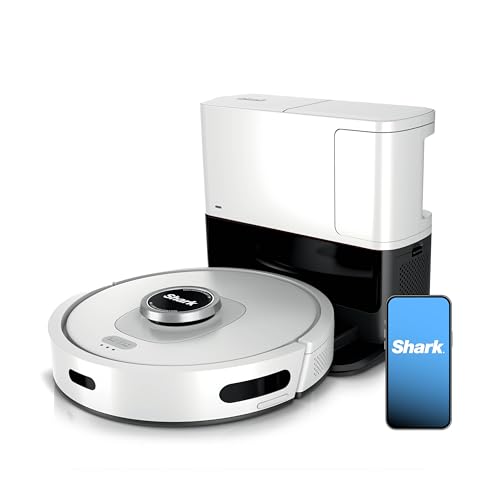
The bagless base holds up to 60 days of dirt and debris and empties after each mission. That is a major convenience feature for anyone who wants less bin handling and fewer interruptions between runs.
This matters most in pet homes and in households that run the robot often, because the dock becomes part of the value proposition instead of just a charger. The trade-off is that the base adds bulk and makes the whole system less minimal than a simple robot-only purchase.
The brush roll is designed to pull debris, hair, and dirt from carpets and hard floors, and the product positioning leans hard into pet hair pickup. That makes it a practical fit for mixed flooring where dust and hair move from room to room.
The buyer takeaway is straightforward: this is meant to be a routine cleaner, not a specialty machine for one surface only. If your floors are mostly open and the mess is everyday dust, hair, and crumbs, the setup makes sense. If you need deep-edge perfection or flawless obstacle handling, the limits show up faster.
Matrix Clean uses a grid pattern with multiple passes, and the robot can recharge and continue where it left off. That combination matters when you want more coverage without manually restarting the job.
It gives the robot a better shot at finishing a room that needs extra attention, but it also signals that the machine is built around methodical coverage rather than speed. For buyers, that is a fair trade if routine cleaning is the goal and you are willing to let the robot take its time.
In a home with a mix of carpet and hard floors, the first thing that matters is whether the robot can keep the routine simple enough to use often. This one is built for that kind of job, with LiDAR mapping, app-based room selection, and self-emptying that removes one of the most annoying chores from the cycle. The practical upside is obvious for daily maintenance: you can send it after a room or the whole floor without treating every run like a project. The limitation is that this is a convenience-first robot, not a carefree one, so homes with clutter or awkward transitions still ask more from the owner than the marketing tone suggests.
For pet hair cleanup, the fit is stronger. The combination of strong suction, a multi-surface brush roll, and the self-emptying base matches the kind of floor mess that builds up fast in real homes with shedding pets. That matters because the machine is not just collecting debris, it is also reducing how often you need to think about the bin. A 110-minute battery rating gives it enough room for many routine jobs, but the battery complaints in the review mix keep this from becoming a full-home, no-drama answer for every layout. If your house is large or the route is complicated, the recharge-and-resume promise helps, yet it does not erase the fact that some owners are clearly running into runtime frustration.
The mapping and app side is where the buying decision gets sharper. A robot that can build a precise map, let you pick rooms, and support Matrix Clean is a better match for people who want targeted cleanup rather than a random pass through the house. That also creates the main trade-off: the more you rely on mapping and no-go zones, the more you are buying into software behavior and home layout compatibility, not just suction. In a simpler home, that is a good trade. In a more complex one, the same feature set can turn into extra setup work and occasional routing annoyance.
Community
The pattern is easy to read: buyers who want simple setup, good mapping, and less bin emptying tend to be happy, while the complaints cluster around units that misbehave, get stuck, or underdeliver on cleaning. The practical lesson is that the automation features are real advantages, but they do not cancel out layout sensitivity or the occasional quality-control headache.
Other than that, this vacuum is easy to set up and use.
Maps your house and then you can select which rooms you want it to clean or the whole area. Very easy to set up no complaints.
It’s pretty intuitive and has yet to get stuck. The battery only seems to last about 65 mins before draining to 30%.
It was not working at all and even after troubleshooting it still did not move out of its dock.
| Attribute | Shark RV2302AE Current | Eureka E20 Plus | Shark Matrix Clean AV2511AE | Dreame D10 Plus |
|---|---|---|---|---|
| Price | 499 USD | 382.49 USD | 319.99 USD | 299.99 USD |
| Battery life | 110 minutes | - | Up to 90 minutes | Up to 285 minutes |
| Suction | Powerful suction | 8000Pa | Powerful suction | 6000 Pa |
| Navigation | 360° LiDAR vision and object detect | LiDAR navigation with AI 3D obstacle avoidance and night vision capabilities | 360° LiDAR navigation | LiDAR with smart mapping and obstacle avoidance |
| Dock | Bagless self-empty base with 60-day dirt and debris capacity | Bagless self-emptying station with up to 45-day capacity | Bagless self-empty base with 60-day capacity | Self-emptying base with 4 L dust bag |
| Mopping system | Not included | Robot vacuum and mop combo | Vacuum only | 2-in-1 vacuum and mop with 150 ml water tank and 3 flow settings |
| App control | Shark Clean app with map-based room selection, Matrix Clean, and scheduling | - | - | Dreamehome app with multi-floor mapping, virtual boundaries, and no-mop zones |
| Editorial score | 67/100 | 72/100 | 70/100 | 77/100 |
Against the Eureka E20 Plus, this Shark is the more convenience-first pick if you want the longer 60-day bagless base and a clearer pet-hair angle. The Eureka brings 8000Pa suction, AI 3D obstacle avoidance, and a 45-day bagless station, so it makes sense for buyers who want a more clearly specified obstacle-avoidance route and do not need Shark’s exact dock style. Choose the Shark for the self-emptying routine and app-driven room control; choose the Eureka if obstacle handling is the bigger concern.
Compared with the Dreame L40 Ultra, the Shark is much simpler in ambition. The Dreame sits in a higher-automation class with self-emptying, self-refilling, hot-water mop washing, drying, and mop lift, plus 11,000Pa suction and a built-in camera with LED light. That makes the Dreame the better route for buyers who want a premium all-in-one cleaning station, while this Shark is the cleaner fit for someone who mainly wants vacuuming, mapping, and a bagless dock without stepping into a much more complex system.
This Shark makes the most sense for buyers who want a mapped, self-emptying robot vacuum for carpets and hard floors, especially in homes with pets. The app control, LiDAR navigation, bagless dock, and 110-minute battery rating give it a strong convenience story, and if the current offer is close to the middle of the robot-vacuum market, the feature set can justify the spend for the right home. The reservation is that the ownership experience is not clean enough to call it a safe default pick. Mixed reliability reports, occasional dock and battery complaints, and the need for a relatively clear floor plan all matter here. If you want the better-documented route, this is a good fit for routine cleaning and pet hair; if you need a robot that feels more forgiving or more premium in behavior, there are clearer alternatives.
Still, compare Shark RV2302AE with close alternatives if warranty, noise, real battery life, or included accessories are decisive for you.
Yes. Its mapping, self-emptying base, and Matrix Clean make it a better fit for routine upkeep than for occasional deep-clean heroics.
No. This model is a vacuum-only machine, so mixed-floor buyers who need mopping should look at a different route.