Key features
Self-empty base that cuts routine chores
The bagless base is one of the most practical reasons to consider this model. Shark rates it for up to 60 days of dirt storage, and because it does not rely on replacement bags, the ongoing routine is simpler than some dock systems.
That matters if your goal is real automation rather than just remote control. A robot that still needs constant dustbin attention stops feeling automatic very quickly, and this setup is better aligned with busy households and pet-heavy floors.
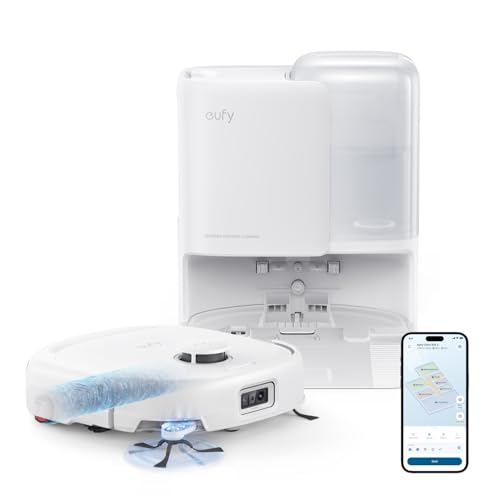
Vacuum and mop in one pass
This is a true 2-in-1 design, not a vacuum-only robot with a token wipe feature. Sonic mopping and app-directed Matrix Mop zones give it a more purposeful hard-floor role, especially for kitchens, entryways, and everyday tracked-in mess.
The caveat is that this is maintenance mopping, not deep scrubbing for neglected floors. If you want your robot to replace a manual mop entirely, this category still asks for compromise.
LiDAR mapping with edge focus
LiDAR navigation is the feature that changes this from a basic robot into a more deliberate cleaner. It can map the home, work in a methodical pattern, and use corner recognition plus targeted air blasts to improve edge pickup.
In practice, that means better fit for room-by-room cleaning and less of the wandering behavior that makes cheaper robots feel slow. It also means this model is more attractive in larger homes than a simple random-navigation alternative, as long as your layout is fairly conventional.
HEPA base for dust-sensitive homes
The self-empty base uses True HEPA filtration rated for 99.97% of particles down to 0.3 microns. That is important because self-emptying docks can otherwise turn a cleanup step into a dust event.
For allergy-conscious households, the benefit is not just cleaner floors but cleaner disposal. It is a meaningful quality-of-life feature, especially when the robot is collecting pet hair, fine dust, and litter scatter every day.