
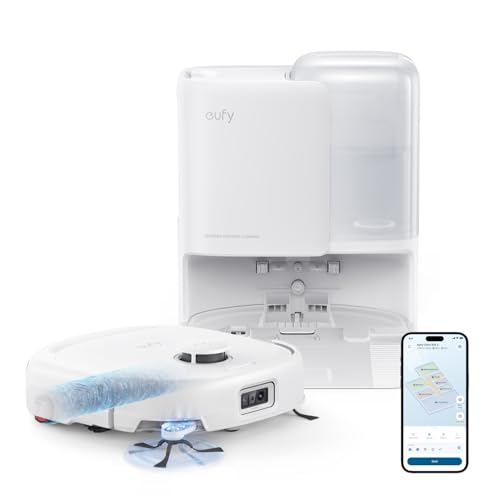
eufy Omni E25
Good fit for pet hair and mixed floors. 110V and 2.4GHz requirements narrow compatibility.
Read reviewBest overall: eufy Omni E25. We compared 10 robot Vacuums using current price, editorial assessment, and buyer feedback.
The ranking weighs current price, editorial assessment, useful technical data, and buyer feedback.
Good fit for pet hair and mixed floors. 110V and 2.4GHz requirements narrow compatibility.
Read review
Good value when found in the lower price band. The automation is excellent, but not fully hands-off.
| eufy Omni E25 | 20,000 Pa | 8.3 | 8.9 | $629.99 |
| Dreame L40 Ultra | 11,000Pa | 7.9 | 9.2 | $599.90 |
| Dreame X40 Ultra Complete | 12,000Pa | 7.3 | 9.0 | $599.99 |
| eufy X10 Pro Omni | 8,000 Pa | 8.0 | 9.0 | $699.99 |
| eufy C28 Robot Vacuum and Mop Combo | 15,000 Pa | 8.3 | 9.5 | $799.99 |
If you want a robot vacuum that can handle both daily debris and mopping without turning the dock into a chore, the eufy Omni E25 lands in a very specific lane. The appeal is the combination of 20,000 Pa suction, a roller mop that self-cleans during the run, and an all-in-one station that empties, washes, refills, dries, and stores wastewater. The trade-off is that this is a full-featured system with a premium price and a 110V, 2.4GHz setup, so it fits best when you want automation first and compact simplicity second.
The Dreame L40 Ultra is for a buyer who wants a robot vacuum and mop that can take over day-to-day floor care with as little babysitting as possible. Its appeal is the mix of 11,000Pa suction, a self-emptying dock, hot-water mop washing, and mop lift for mixed floors, which makes it especially relevant in homes that juggle hard floors, rugs, pets, and a lot of tracked-in mess.

The Dreame X40 Ultra Complete is aimed at buyers who want a robot vacuum that can handle both daily debris and regular mopping with less hands-on cleanup. Its appeal is the mix of strong suction, liftable and removable mops, and a dock that washes, dries, empties, and refills, which puts it squarely in the premium automation lane. The main trade-off is that this kind of convenience comes with a higher upfront cost and a more complex dock than a basic self-emptying robot.

The eufy X10 Pro Omni makes the most sense for a home that wants vacuuming and mopping to disappear into one routine, especially if you value a dock that handles more than just charging. Its appeal is the mix of 8,000 Pa suction, dual mops with auto-lift for carpet, and a station that washes, dries, empties, and refills without much babysitting. The trade-off is that this is a full automation setup, so the dock and its consumables are part of the ownership experience, not an afterthought.

The eufy C28 makes the most sense for a buyer who wants one robot to handle both vacuuming and mopping, especially in a pet-heavy home where hair, crumbs, and tracked-in messes pile up fast. Its 15,000 Pa suction, HydroJet roller mop, zero-tangle brush design, and self-emptying, self-washing dock give it a clear automation angle, but the real trade-off is that this is a dock-dependent cleaner built for convenience, not a lightweight grab-and-go robot.
The ranking compares published products with a stable framework: editorial quality, buyer signals, current price when the preset requires it, and comparable category metrics. It does not claim original lab testing; it documents how available signals are weighted so the order remains auditable.
Setup: Collect published reviews, current product data, and comparable technical fields.
Measured variable: Coverage for current price, rating, local review URL, and primary category metrics.
Evaluation rule: Only updated products with enough comparable data can enter.
Setup: Cross editorial score, buyer signals, and price when the preset requires it.
Measured variable: Normalized ranking score on a traceable 0-100 scale.
Evaluation rule: The winner must sustain a stronger balance than the finalists, not just one isolated metric.
This ranking is refreshed from published reviews, current category catalog signals, editorial scoring, and current price. Scores are calculated against the eligible category universe; the visible top only shows the models that pass the final cut.
Descending order: the winner has the strongest balance of Q_final and normalized price against the eligible category universe.
Buyer signal uses the scoring v2 Bayesian score; it is not a simple stars times two conversion.
Computed against eligible comparable category candidates, not only against the visible top. P05=263.422; P95=1568.49.
If a critical axis falls below the threshold, final quality is penalized so one weak product cannot win only on price.
| Tikom L8000 Plus | 72.3 | Navigation and app: 8.8/10. | Mopping quality: 7.5/10. |
| Roborock Saros 10R | 70.8 | Dock and maintenance: 9.3/10. | Cleaning performance: 5.3/10. |
| Eureka E20 Plus | 68.7 | Navigation and app: 8.9/10. | Mopping quality: 7.5/10. |
| Dreame X60 Max Ultra Complete | 49.8 | Dock and maintenance: 8.3/10. | Cleaning performance: 5.4/10. |
| Roborock Saros 20 | 48.6 | Dock and maintenance: 8.3/10. | Cleaning performance: 5.8/10. |
It does not mean choosing the cheapest product by default. The ranking crosses editorial score, buyer satisfaction, useful technical data, and updated price to identify the model with the most defensible balance.
The page prints the latest available refreshed price to make comparison clearer, but Amazon can change price and availability at any time. The live purchase link remains the final check before buying.
Yes. The preset ranking keeps the editorial frame, URL, and components stable while recalculating internal positions when comparable data changes or new models enter the catalogue.
The ranking is not meant to list the whole catalogue. A model first needs a published review, a current price, and comparable signals; then only the set that clears the operational cut is ordered. A product can stay outside the visible top when its price is stale, it has no public URL, its useful data is incomplete, or its balance of quality, user signal, and price remains weaker. This keeps the same freshness gate used across the rest of the site.